 |
| Data collected from the 5 cases |
Friday, April 15, 2011
Results from Newton's Lab... who says getting hit in the head can't help you?
After a long time I was able to have fun with pulleys and loads. We were to differentiate between mass and force with acceleration. There were 5 different cases we were to follow and produce results. These are the results that I collected with my group :)

The tower is falling down... falling down
So last week we did another fun activity: constructing a tower. I should mention its not as easy as it sounds with limited tape and newspaper, yet again. That was all we received with even less time! My group and I started with cylinders for the base and for the top we rolled the rest of the papers and stuck it on the top. However, the top was ending up with more weight. Thus, it kept bending :( We tried repeatedly to fix the problem but it's not like we had any more materials to strengthen the base. Then out came Mr.Chung and said time out. We tried to improve it even after time was up :P well until Mr.Chung was judging our (if you can even call it that) tower... So now it is evident that we were unsuccessful. But all creators fail at some point or the other right? I take this in the positive way and I know what I would have to do to produce better results next time :)
 |
| How it all started... |
 |
| so yeah it won't stay down :P |
Tuesday, April 12, 2011
How High Can You Go?
Ever wondered if there are structures taller than our own CN Tower? Well in reality the CN tower is ranked around the 100's for tallest structure. At number 1 we have Burj Khalifa with an enormous height of 828 m (2717 ft.) What has enabled this structure to maintain such a grand height? Usually when designing a building the main considerations to create a successful building is:
1. The use of strong, unbreakable materials
2. The shape. Usually we see buildings decrease in width from top to bottom. This increases stability. Of course we can't forget the triangles. It had been put into our heads since grade two that it is the strongest shape out there!
3.Weight can be another factor. We can't have a heavier top than bottom... The base should have the most mass.
4. Having a low centre of gravity which minimizes risks and difficulties
1. The use of strong, unbreakable materials
2. The shape. Usually we see buildings decrease in width from top to bottom. This increases stability. Of course we can't forget the triangles. It had been put into our heads since grade two that it is the strongest shape out there!
3.Weight can be another factor. We can't have a heavier top than bottom... The base should have the most mass.
4. Having a low centre of gravity which minimizes risks and difficulties
 |
| Burj Khalifa - Tallest Structure in the World! |
Tuesday, April 5, 2011
What Goes Up Must Come Down!
We have now started a new section in our unit in kinematics : projectile motion. It seems very complicated at first but eventually you get the hang of it. These are the answers from 1-9 in the projectile motion worksheet.


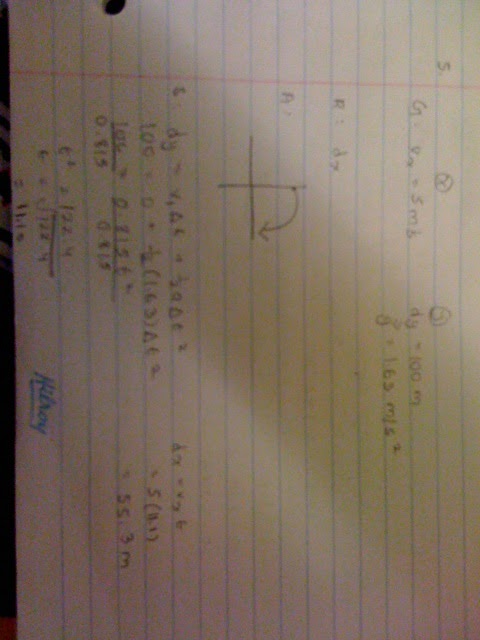


Monday, March 28, 2011
Egglander or Egg Failure?
Today we were given a new project which would begin on wednesday; it is a gliding egg lander. Let's start by defining aerodynamics. It is the study of forces and the resulting motion of objects through the air. Now what does this have to do with eggs? Well as I mentioned, the egg does have to somewhat fly and to be successful in doing so, we have to know some information about aerodynamics: the study of air and its motion. For this project we will be given 25 straws, one sheet of newspaper, and a limited amount of tape. Learning that was all we had to work with, my group and I got really depressed. However, as Mr.Chung always says: never get freaked out by problems; just slowly and intelligently work it out (changed into my own words of course haha)... To do well on this project, the best thing would be to determine what kind of shape we should use to protect the egg. Obviously the first thing that came into my mind is the structure of a hang glider. Therefore to make our egg glide well enough, making wings for it would be a good idea and making a cushion is good for a safe landing. More brainstorming will be needed evidently but hopefully we can make a good egglander :)
 |
| A design I liked made by well some kids in college :P |
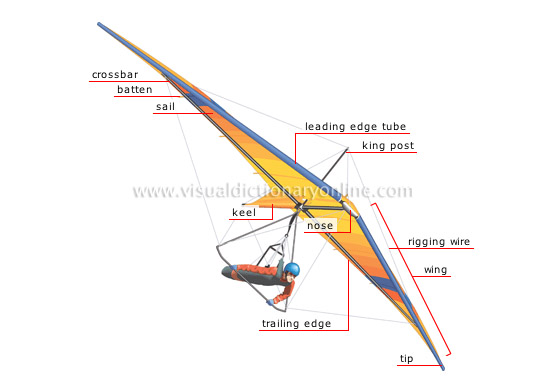 |
| A design of a hang glider |


Tuesday, March 8, 2011
If At First You Don't Succeed, Try, Try Again
Today was basically the first day we started kinematics or in other words the motion unit. Mr.Chung had divided us in 7 groups and I was chosen as the leader. My job was to setup the equipment and explain to my group members what we were suppose to do and how. They got the hang of it pretty fast! The objective of the activity was to match our walking patterns to the pattern of the distance-time graphs or velocity-time graphs using a motion detector.
A. Stand at 1m away from the origin and stay at rest for 1s
B. Jog 1.5 m [E] away from the origin in 2s at a constant speed
C. Stand 2.5 m away from the origin for 3s
D. Jog 0.75 m [W] toward the origin in 1.5s at a constant speed
E. Stand at 1.75 m away from the origin and stay at rest for 2.5 s
A. Start at a distance of 3 m away from the origin and jogs 1.5 m [W] toward the origin in 3s at a constant speed
B. Stand 1.5 m away from the origin and stay at rest for 1s
C. Jog 1 m [W] toward the origin in 1s
D. Stand 0.5 m away from the origin and stay at rest for 2s
E. Jog 2.5 m [E] away from the origin in 3s
A. Stay at a velocity of 0 (rest) for 2s
B. Speed is increased to 0.5 m/s [E] during 0.1 s
C. Speed of 0.5 m/s [E] is maintained for 2.9 s
D. Object quickly speeds up in 0.1 s at 0.5 m/s [W]
E. Stay at a velocity of 0 (rest) for 1.9 s
F. Speed is increased to 0.5 m/s [W] during 0.1 s
G. Speed of 0.5 m/s [W] is maintained for 2.9 s
A. Increase to a speed of 0.5 m/s [E] going away from the origin for 4s
B. Maintain speed of 0.5 m/s [E] for 2s
C. Speed is at 0 m/s [W] during the 0.1 s
D. Maintain a speed of 0.4 m/s [E] for 3.9 s
E. Speed up for 0.1 s at a speed of 0.4 m/s [E]
F. Stay at a velocity of 0 (rest) for 0.9 s
A. Stand about 0.8 m [E] away from the origin and jog 1m away from the origin for 3.5 s
B. Stand 1.8 m [E] away from the origin and stay at rest for 3 s
C. Jog 1.5 m [E] away from the origin in 3.5 s
Some things to know:
D-T Graphs (B,C, F)
-If the slope is inclining, walk away from the origin
-If there is no change in the line (slope of 0), stay still
-If the slope is declining, walk toward the origin
-The speed at which you have to walk depends on the time you have to walk it in
V-T Graphs (D, E)
-If there is no change in the line (slope of 0), the speed is constant
-If the velocity is at 0, there is no movement
-If the line inclines or declines, there is an indication that the speed is changing
Reading D-T or V-T graphs can be quite confusing. Therefore, you should carefully analyze the graphs.
 |
| The result for graph B |
B. Jog 1.5 m [E] away from the origin in 2s at a constant speed
C. Stand 2.5 m away from the origin for 3s
D. Jog 0.75 m [W] toward the origin in 1.5s at a constant speed
E. Stand at 1.75 m away from the origin and stay at rest for 2.5 s
 | |
| The result for graph C |
B. Stand 1.5 m away from the origin and stay at rest for 1s
C. Jog 1 m [W] toward the origin in 1s
D. Stand 0.5 m away from the origin and stay at rest for 2s
E. Jog 2.5 m [E] away from the origin in 3s
 | |||
| The result for graph D |
B. Speed is increased to 0.5 m/s [E] during 0.1 s
C. Speed of 0.5 m/s [E] is maintained for 2.9 s
D. Object quickly speeds up in 0.1 s at 0.5 m/s [W]
E. Stay at a velocity of 0 (rest) for 1.9 s
F. Speed is increased to 0.5 m/s [W] during 0.1 s
G. Speed of 0.5 m/s [W] is maintained for 2.9 s
 |
| The result for Graph E |
B. Maintain speed of 0.5 m/s [E] for 2s
C. Speed is at 0 m/s [W] during the 0.1 s
D. Maintain a speed of 0.4 m/s [E] for 3.9 s
E. Speed up for 0.1 s at a speed of 0.4 m/s [E]
F. Stay at a velocity of 0 (rest) for 0.9 s
 |
| The result for Graph F |
B. Stand 1.8 m [E] away from the origin and stay at rest for 3 s
C. Jog 1.5 m [E] away from the origin in 3.5 s
Some things to know:
D-T Graphs (B,C, F)
-If the slope is inclining, walk away from the origin
-If there is no change in the line (slope of 0), stay still
-If the slope is declining, walk toward the origin
-The speed at which you have to walk depends on the time you have to walk it in
V-T Graphs (D, E)
-If there is no change in the line (slope of 0), the speed is constant
-If the velocity is at 0, there is no movement
-If the line inclines or declines, there is an indication that the speed is changing
Reading D-T or V-T graphs can be quite confusing. Therefore, you should carefully analyze the graphs.
Subscribe to:
Posts (Atom)